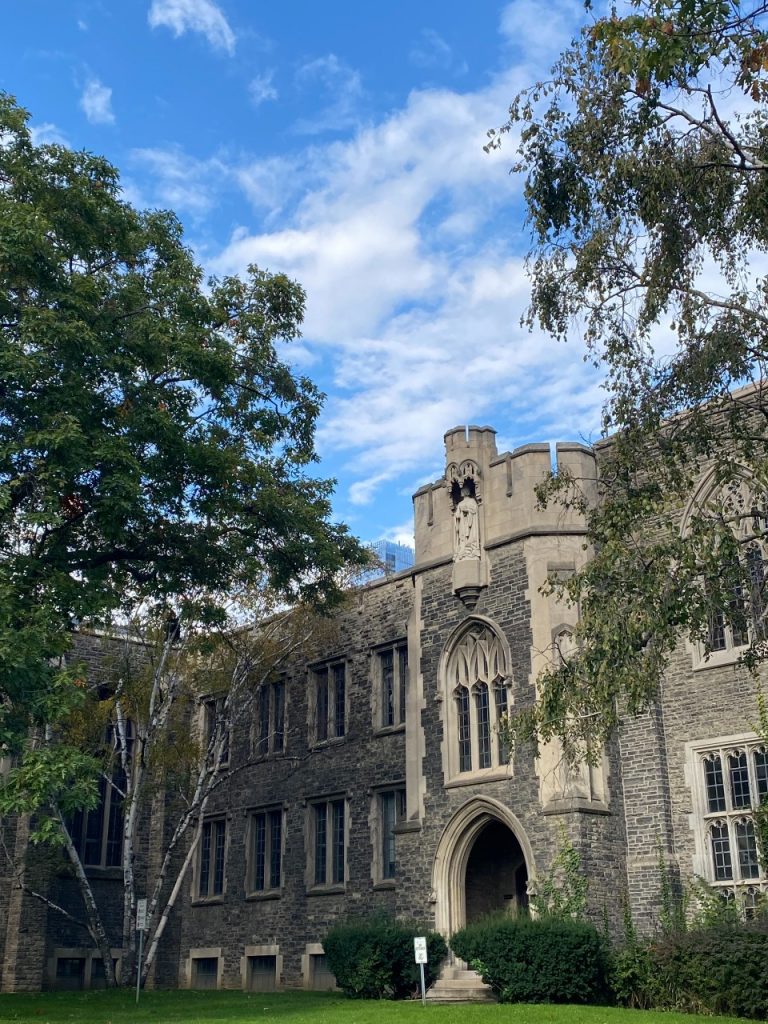

An Artsy Afternoon

Contemporary art and I have an interesting relationship. Sometimes we get along, like two dancers weaving to a rhythmic beat, and other times we tip-toe in each others’ spaces, like hesitant friends at an awkward dinner party.

So it was with a bit of a sense of the unknown that I made my way to the Justina M. Barnicke Gallery to check out the current exhibition, I Thought There Were Limits. As I stepped into the gallery, I reacted as I usually do when it comes to contemporary art exhibits. I wondered: where is the art, and why is there so much space? I like creating art, but my paintings and drawings are a mish-mash of colours and shapes, words and half-finished poems, swirls, strikes, dots, random pairings of patterns and symbols…absolutely nothing like the art that stood staring back at me, daring me to take a leap.

And so, I leapt.

According to the colourful program that I picked up, the exhibit brings together five artists who “engage with both the material and conceptual dimensions of space”. Ah, Space, that most elusive of things. The exhibit spans two rooms, with one room hosting most of the art pieces, and the other engulfed by Kika Thorne’s piece titled Singularity (pictured below). I won’t go into detail about each work of art. I want you, my friend, to go and take a look!

Singularity by Kika Thorne

However, one piece caught my eye. It took the shape of a giant shiny silver blanket of sorts, slightly crumpled and lying on the floor. Not surprisingly, the piece was called Space Blanket, by Josh Thorpe. Yet it was the sound recording that formed the backdrop for the blanket which got me thinking. At first I thought I was hearing noise from the subway cars (if you’re ever in a lecture at OISE, you know what I’m talking about). Then, as I listened more closely, I realized that what I was hearing was a succession of footsteps that got increasingly louder, and then simply fell away. Intertwined with the sound of footsteps was the sound of classical music.

It could have been my imagination (that afternoon sunlight can play tricks sometimes). but every time the footsteps grew louder, the silver blanket moved ever so slightly – just enough to make me believe that perhaps it was moving on its own.

All of which got me thinking about Space. I was the gallery’s only visitor. I closed my eyes and listened to the sounds around me. It seemed as though time had stopped, and I was carried by whatever note the music played next. I opened my eyes and found myself in rather empty space filled with sound and a few works of art. I realized that the title for the exhibit – I Thought There Were Limits – fit really well. There are no limits, until you create them. The art that did have physical limits in that open space did not have limits in my mind. Now that, my friend, is profound.

Since I had thought all the deep thoughts I had inside me, it was time to go. I really enjoyed Josh Thorpe’s work, but I could only reflect for so long on potential interpretations. So, off I went, only to be bowled over in Hart House’s next corridor by the Hart House Camera Club’s annual exhibit.

According to their website, the exhibit ended on April 21. I managed to catch it, and you may have a chance as well in the next couple of days. I must have spent a good 20 minutes immersing myself in all of the photographs, and creating stories as I went along. The photographs are fantastic!

Aaron Tan’s Tension is a compelling piece:

Tension, by Aaron Tan

Art Chow’s work is also wonderful:

Observer, by Art Chow

I was pleasantly surprised by both Justina M. Barnicke’s current exhibit, and my spontaneous discovery of the Camera Club’s eye-opening exhibit (its 91st edition, I might add). Have a spare hour or so? Treat yourself to an afternoon of art at Hart House. You may just be inspired to create spaces and stories of your own!

-Aziza

For more information about Hart House’s Camera Club, check out their website.

The Best of Life @ U of T (according to me)

Well I’m sad to say that this will be my last post for the Life @ U of T blog. What a crazily-awesome year it was and I honestly have no idea where the last 25 weeks went. I’ve had a blast being your Faculty of Arts & Science Student Blogger and I hope you guys got as much enjoyment in reading my posts as I had in writing them.

For my last post I want to do a “Best Of” the blog over the past year — featuring a favourite post of mine from each of our lovely bloggers. If you have never read Life @ U of T before these posts are a great way to start!

Abdullah — “oppression, equity and politics” — In this post Abdullah tackles the sensitive subject of equity — or lack thereof — that sometimes has a tendency to surface in the student sphere. While we can all be proud to claim that U of T is a highly diverse and multicultural school, we also have to be cognizant of the fact that sometimes situations of inequity arise and Abdullah does an excellent job in addressing an instance in which he experienced it firsthand.

Ishita — “The Art of Forgiving Yourself” — In this post Ishita discusses the pressures many students experience — especially in their first year — to do well at the U of T and the feelings of failure many of us inevitably face when we fall short of the goals we have established for ourselves. Ishita reminds us that mistakes and missteps will happen and that’s OK, so long as we learn from our experience and leverage it for the better.

Lesia — “Hey U of T, it’s time to get moving!” — As the Physical Activity Blogger I find all of Lesia’s posts highly important and relevant to me personally (as someone who tends to neglect the gym…and every other form of physical activity). The tendency to simply hunker down at your desk and neglect exercise, indulging in less-than-optimal eating habits as a coercive mechanism to get you through your readings or that big assignment is very strong for many of us. Lesia reminds us of the importance of maintaining a healthy lifestyle and many of her posts feature the free services and activities available to students in pursuit of it.

Lori — “Raise your hand!” — In this post Lori discusses strategies you can use to try and make yourself a bit more engaged in class discussions — in an attempt to get those ever-tricky participation marks. Her advice is highly relevant, especially for upper-year seminar courses where large chunks of your grade require you to do something many of us dread: public speaking.

Sarah — “Post-Grad Blues” — In this post Sarah does an exceptional job encapsulating how many of our fellow graduating students may be currently feeling. Come May 1, many graduating students will be — for the first time in their lives — completely without the life-structuring mechanism school provides. In addition to this, many students may also feel torn about what exactly the want to do post-undergrad, with different forces pulling them in different directions.

Shak — “TTC? Why man why????” — In this post Shak discusses (or perhaps rants would be a more optimal phrase) about the one transportation service we all love to hate: the TTC. As a commuter myself, I found Shak’s post highly relatable and funny — well worth a read for all those who have, at one point or another, felt slighted by the Toronto Transit Commission.

Vahini — “College Governance 101” — Vahini offers a great introduction to all the various student councils that govern each of U of T’s disparate colleges. In a school as large as U of T, it’s important to know what governing structures are relevant for you! This post is actually part one in a three-part series and her posts about Councils and Unions and Student Societies are worth checking out as well!

Vivian — “The Breakfast Club” — In this post Vivian discusses all the benefits of having a healthy breakfast before going about your day. As someone who tends to neglect this important meal, I found the post very insightful. We are all told how breakfast is ‘the most important meal of the day’ and Vivian demonstrates this!

Of all the posts I’ve written this year I would have to say that my post “Surviving the Winter: Tips for Commuters” is one of my favourites as commuting to school in the winter can be a tedious and downright awful experience for many of us — especially when you consider the fact that winter in Toronto last from November to April (apparently).

I hope you have all found value in reading this blog — I know I have — and if this is your first time on the site be sure to check out all the posts I mentioned above! I’d like to thank the Faculty of Arts & Science for giving me the opportunity to write for all of you as well as the Office of Student Life and the entire Student Life Community Crew for being such a wonderful and awesome group of people!

- Matteo

oh the places you’ll go.

“You have brains in your head. You have feet in your shoes. You can steer yourself any direction you choose. You’re on your own. And you know what you know. And YOU are the one who’ll decide where to go…” – Oh The Places You’ll Go, by Dr. Seuss.

Surprisingly, that quote and that video are related. Unfortunately, it has nothing to do with a grand conspiracy involving John Lennon, Dr. Seuss and an impostor who acted as Paul McCartney after the real Paul died.  It has to do with my days in elementary school. One grade, I forget when, my teacher opened up class by reading the Seuss book. And then later, we celebrated the retirement of a Beatles-crazy teacher by singing “Hello, Goodbye” in an assembly fit for Sergeant Pepper himself. One event marked the beginning of something, the other was part of a fitting end to a career. Here was the beginning and now, my friends, this marks the end of our blogging journey together.

When I started blogging this year, I had just finished my first year and now all of a sudden, I’m heading into my third year. I’m sure many of you are asking the same question. “Oh my! I’m graduating!” “I’m going into second year!” “I’m going into my LAST year! OMG.” “OMG YAY UNIVERSITY HERE I COME.” Chances are you are saying one of those things right now. I’d like to think that I’ve grown over this past year, and chances are I have — but it’s gone by so quickly, that it’s really hard to tell. This year, I had the chance to do so many things, from joining ASSU to stuffing myself at a barbeque to engaging in weekly religious discussions about life, to volunteering at a soup kitchen. And I discovered Diabolos and took out a book from stacks for the first time! I realized that we all fill the void in each other’s lives with our stories, that we shouldn’t necessarily define ourselves by our prospective careers and that we should carry out our discussions in an atmosphere of respect. I hope you had just as a good time reading about my journey this year as I did living it.

So here we are. No matter what stage you are at in your university career, we will still all be going somewhere. Either you will be stepping on this campus for the first time come September and remark that everything looks like Hogwarts.

Or you’ll strut across the stage at Convocation Hall in June making 35325235235 hours spent in Robarts worth it.

Or maybe you’re like me, at the middle of your university career. Wondering whats next.

And well, in my case, I don’t know whats next. But I know that opportunities are lurking around each corner on this campus, and it is up to me to go and seek them out. Up to me to ultimately get the university experience I want both inside and outside the classroom. You may be wondering whether you are doing things right, or whether you are involved enough, or whether you are too anti-social, or if you should change majors because you aren’t interested in the material. These are questions we all have to deal with during our undergraduate career. But, despite being unsure of the future, I do know what I have learned.

At U of T, there are a lot of opportunities waiting for you. This is the most accessible research university in the country, top notch professors and wide variety of courses await you. Our campus is steeped in history and breathtaking architecture. You can have coffee in the JCR, study Drosophila at the Earth Sciences Centre and have some Zumba fun at Hart House all in one day. Now, life at U of T, I admit, isn’t always a paradise. It’s hard and I’m struggling to adapt as well, still in my second year. What I’ve learned is, we should be confident in our own abilities and not fret over the accomplishments of others. This is our undergraduate career and we should take it at our own pace. Do what you can handle, there’s no need to experience all of U of T. We all have different niches on campus after all. But don’t be afraid to step outside of your comfort zone once in a while to try something new.

And if you ever feel stressed sometimes, like I do, stop and take a breather. Focus on the little things. Your coffee from Diabolos, small concepts in your lectures, the beauty of the downtown campus on a spring day. In the hustle and bustle of student life, sometimes its just helpful to stop and take note of our surroundings.

It’s been fun blogging for you, U of T. Go out and do big things. I’ll see you later.

- Abdullah

Reflections on First Year at U of T

Seeing as how the school year is rapidly coming to an end, I thought it might be apt to share the experiences had this year by one of the university’s newest members — a first year student. In pursuit of this I approached student life rising star Jelena Djuric (pictured below) to get her take on her first-year experience at Canada’s leading academic institution. My questions are in bold with Ms. Djuric’s response following subsequently.

I would like to thank Jelena for agreeing to being featured in this week’s post.

What classes did you take in your first year? Any in particular that you enjoyed? What Program of Study do you hope to pursue going forward?

This year I took five full-year courses, allowing me to have a more spread out workload. I took POL101 (Democracy, Dictatorship, War and Peace), HIS103 (Statecraft and Strategy: An Introduction to the History of International Relations), ECO105 (Introduction to Economics for Non-Majors), DTS200 (Diaspora and Transnational Studies), and a first year seminar titled “The Embarrassment of Scripture”. So far, my political science and history course have been most engaging. I intend to pursue an International Relations Specialist degree, or a double major in International Relations and Political Science. However, a Peace and Conflict Studies major/minor is still an option following second year.

What, in your opinion, was the hardest part about your first year as an undergrad? How did you cope? Would you offer any advice to incoming students who may face a similar issue?

As a residence student, I experienced many distractions on a daily basis. I dealt with this by being in the library and ensuring I was being productive while I was off residence. With the constant urge to socialize with new friends, I understand this may seem easier said than done. I would recommend incoming students facing a similar barrier to getting their work done to motivate their peers to do the same. That way, when productivity is achieved, everyone gets to reward themselves!

What extracurricular activities did you get involved with this year?

This year I had the pleasure of serving as an elected member-at-large on my college’s student council! Being on VUSAC (Victoria University Student Administrative Council) was definitely one of the most rewarding experiences I have had so far. It allowed me to form multiple relationships with many like minded students across campus. As a member-at-large I helped to organize UofT’s annual Winterfest, the Victoria College annual formal Highball, in addition to being a member of the Budget Steering Committee. Additionally, I had the opportunity to debate at Yale University and McGill University with the Hart House Debate Club. I am also a policy analyst for the G20 research group, analyzing the commitments made by G20 member states in the area of climate change.

What motivated you to get involved?

Before going in to university, I was already immensely passionate about governance, political debate and so on. I knew that in order to engage in these passions I could not solely rely on the ‘lecture experience’. I also knew that constantly doing readings and essays would not give me the best university experience. I knew I wanted to share my passions with students and I knew I could find that by getting involved at UofT.

Where did you first hear about the extracurricular activities you are currently involved with?

I heard about VUSAC during frosh week, and I knew I could positively contribute to the council. As for debate, I was already a member of my high school debate team. In terms of the G20 research group, I accidentally stumbled across it while reading John Ralston Saul’s book “The Collapse of Globalism and the Reinvention of the World”. For no particular reason, I looked up a footnote and realized he cited his information from the G20 research group based at the university. When I realized I too could contribute to the report, I immediately applied to be a policy analyst!

What’s your favourite thing you did this year outside of the classroom?

This year I signed up for two sessions that are a part of a Vic initiative titled “Ideas for the World”. Every week, students get together with a professor over lunch for 2 hours to discuss various, often controversial and thought provoking topics. In the fall, I was in “Environment and Economics”, and I am currently in “Culture and Conflict in the Media”. The unique part of this program, is there are no marks or assignments. You simply show up, watch a video, and have an intellectually stimulating discussion. This was a great way to voice my opinions on various issues without fear of getting a bad grade!

What was your favourite thing you did inside the classroom?

I believe my favourite thing has been the freedom to research a wide array of topics that are of interest to me. For example, I am currently in the process of researching the Serbian diaspora situated in North America in the post-communist order and the impact the breakup of Yugoslavia has had on the creation of the Serb identity. And this is for my diaspora and transnational studies class! It is very exciting to be able to delve in to a topic that deeply resonates with me.

What extracurricular activities do you hope to purse next year?

I plan to continue to pursue all the activities I am currently involved in. I am also hoping to get involved with the International Relations Society, or with the Association of Political Science Students.

Would you say your extracurricular experiences enhanced the quality of your first year at the University of Toronto?

Without a doubt! Getting involved at UofT has opened up many future opportunities for me.

Would you recommend first year students get involved in extracurricular activities?

YES! I understand going in to university from high school can be very daunting. However, getting involved will give you a sense of community that you may not necessarily find in the classroom or in residence. The campus seems a lot smaller when you see so many familiar faces!

First year students are not typically the students who are most inclined to get involved in extracurricular activities. Can the university do more in promoting the benefits of extracurricular involvement to first year students? What would you like to be seen done?

A lot of students seem to think getting involved means your GPA will suffer. This is definitely a misconception. In fact, the opposite seems to be true. I think the university should promote extra-curricular in a way that accurately shows students who get involved will not only reap social benefits, but their academic experience will accordingly be enhanced.

From Spectating to Participating: the time to get involved is now

With the first week of March now upon us, we students are entering that proverbial ‘crunch time’ of late nights, libraries, and fancy lattes to help us cope with it all.

And this year, more than most, seems to have a lot of stuff crammed into the final six to eight weeks of the semester.

In addition to the assignments, tests, and exams, this time of the year also features plenty of activity in the world of student life as many groups, clubs, and student organizations begin turnover processes, paving the way for next semester – starting September 2013. While you may feel that you don’t have much time to devote your awareness to anything other than your textbooks over the next few weeks, I implore you to keep an eye on the goings on in the student communities you are a part of, as the way in which these communities are shaping up at the end of this semester will have a very real impact on the way they look when classes resume six months from now — unless you’re a graduating student, of course. (If you’re in this boat you have plenty of bigger concerns to deal with………anyone looking to hire a Student Blogger, available for work immediately in early May?…Please?)

The elephant in the room being all this University of Toronto Students’ Union secession business that has been dominating student politics at the university as of late (for the seven of you interested in undergraduate student politics, that is). And while this issue is definitely an important one – especially as the consequences of all of this hullabaloo have yet to be borne out - this is not the only thing happening in student life right now that you should be concerned with.

Student communities take all shapes and sizes, from small college-based clubs to inter-campus wide student associations. What I hope to emphasize is that many of these organizations are holding elections/seeking membership for positions for the upcoming year and if you have ever thought about trying out for one of these positions, the time to do so is now. Don’t simply get caught up in being a spectator to everything going on around you. As cliche as it may sound, the four or five years you spend at the University of Toronto is short (trust me) and if you have ever considered the possibility of enhancing your undergraduate experience through some extra-curricular activity, now is the time to seek those position out.

I know first hand that this can be a daunting task for the uninitiated, but trust me: go for it. The first ‘major’ thing I did in the realm of student life involved running for an executive membership position on the Victoria University Students’ Administrative Council at the end of my second year. I had dabbled a bit in Vic’s student life before then, but I was a relatively unknown candidate and was up against someone who had already been on the council previously and was a somewhat of a known entity around the Vic community. Needless to say I lost the election and while it definitely sucked I gained invaluable insights into how student life functioned at the college as well as had the opportunity to meet a number of people I would not have otherwise met. The experience of running, despite losing, no doubt played a factor in my attaining an elected position on the council in the following Fall election at the beginning of the new term. Leaving my comfort zone was, you’ll be surprised to hear, uncomfortable but the experience was essential in my personal growth (overcoming social anxieties) as well as integrating myself in a community I now have grown to love and adore. There is not a doubt in my mind that if I hadn’t run in that Spring 2010 VUSAC election you would not be reading this post right now.

The moral of the story is, I’m sure, quite obvious. You’ve heard it before but it is worth stating again: your experience as an undergraduate student is what you make it and oftentimes the best experiences in life involve a little risk. Students at the U of T have been known to complain that they experience a lack in communal-feeling with their peers and while this may be true the opportunities to remedy this feeling are out there; you just have to be willing to look.

Why I love U of T

With Valentine’s Day on our collective consciousness I thought that now would be an ideal time to share with all of you the things I love about the institution I have dedicated the past five years of my life to. While the University of Toronto receives a lot of negativity from students for a plethora of reasons I won’t get into here, I am ultimately happy I chose to pursue my undergraduate education at the U of T and with the onset of graduation in a few short months I know that I wouldn’t have wanted to attain my degree anywhere else! Here’s why:

The history

Did you know that the University of Toronto (which was founded in 1827 as King’s College) is older than Canada? I bet you also didn’t know that University College and Victoria University’s Annesley Hall are considered National Historic Sites by the Canadian government! Throughout the university’s long lifespan, many prominent Canadians have called it home, a short list including: William Lyon Mackenzie King, Lester B. Pearson, Adrienne Clarkson, Malcolm Gladwell, Naomi Klein, Margaret Atwood, Donald Sutherland, Harold Innis, Northrop Frye, Marshall McLuhan, C. B. Macpherson, etc. et. al. You don’t have to be a history buff to appreciate university’s long legacy as one of Canada’s premier academic institutions!

The campus

The University of Toronto is an oasis of learning and self-discovery amid the hustle and bustle of Canada’s most prominent urban environment. The campus itself is beautiful, an appropriate mixture of centuries-old buildings and urban planning mixed with modern innovations and cutting edge architectural design. It is easy to forget the sheer beauty that defines the U of T campus as you simply keep your head down in a rush to class in the mid-February cold. Due to its location in Toronto’s downtown, the university offers its students exposure to unique social, economic, and cultural experiences that can only be found in highly developed metropolitan centers.While I can only speak to my experiences with the St. George campus, I hear that the Mississauga and Scarborough locations are nice as well for reasons unique to them!

The Faculty

While not everyone will agree with this assessment, I can honestly say that I have generally had a positive experience with most of my Professors and instructors during my 5 years as an undergraduate student. Faculty are, on the whole, passionate about what they teach and are excited to share their knowledge with you. Some of the most prominent intellectuals and academics today can be found on the Faculty lists of U of T’s various departments and I am grateful to have had the opportunity to study under them.

The students

Perhaps the most important category on this list, the University of Toronto student body is all at once intelligent, sophisticated, socially engaged, and welcoming. While I can only speak to my own experience, some of the most intelligent people I have ever met and some of the best friends I ever hope to meet are University of Toronto students. Canada’s future leaders, intellectuals, and innovators can be found sitting next to you in any given lecture and I am often awestruck at the caliber of student found at the U of T.

The libraries

An appreciation of the wide variety of libraries and the vast collection of academic materials within them is something we as students tend to neglect when thinking about our time at the U of T. Very rarely have I sought to take out a book from one of campuses libraries and found it unlisted. The University of Toronto Libraries is the fourth-largest academic library system in North America — we should not take it for granted.

The prestige 

Call me pretentious, but I enjoy my association with one of North America’s (if not the world’s) premiere institutions of higher learning. There’s a reason students from all around the globe flock to the U of T for study.

Let me know why you love U of T in the comments!

Those Who Do Not Learn From History Are Doomed To Repeat It

“Be kind, for everyone you meet is fighting a hard battle.” — Plato

Cases of extreme violence, like the gang-rape of a 23-year old medical student in New Delhi, India (http://www.cbc.ca/news/world/story/2013/01/21/india-rape-fast-track-court.html), always seem to cause waves of public outrage and protest around the world.  Days after a high-profile rape is reported, the world seems to be calling for an end to sexual harassment and assault.  Posters are plastered across a city hours after a young child is kidnapped. In times of adversity, the masses always seem to demand strict enforcement of laws by authorities.  The anger and sense of justice that seem to awaken in the general public following a tragedy is strangely uplifting.  There’s something so powerful about the entangled voices of complete strangers, fighting for the common good.  It makes me question why the objections and intolerance of injustice die down once time has passed and the cries of the fallen have faded away.  Somehow we can rationalize sitting back and doing nothing because these events have occurred across the world in other countries.  But we often forget that violence occurs everyday, even on UofT’s relatively safe campus.  A boyfriend slaps his girlfriend.  A young student is humiliated online.  A weapon is concealed.  Must we wait for something bad to happen in order to marvel at the state of world and its affairs?  Is there anything we can do?

The Green Dot Program at UofT is about caring.  It’s about refusing to passively accept that so many people are getting hurt.  And most of all, it’s about believing that we all have a responsibility to create a safer campus and world.  The Green Dot Program encourages everyone to focus on reducing the risk of violence in the moment, even if the threat of violence isn’t imminent (http://www.healthandwellness.utoronto.ca/GreenDot.htm).  A green dot is any behaviour, action, word, or attitude that promotes safety for us all.  It can be as simple as spilling a drink if you believe it’s drugged.  Or asking someone who appears to be in trouble if they’re okay.  No action is too small.

We tend to think that this only happens to other people.  That it’s none of our business.  But Cheryl Champagne, the Assault Counsellor and Co-ordinator of the Green Dot strategy at UofT, disagrees.  She says that in every group or classroom that she has talked to about the Green Dot Program anywhere from 40-90% of students in the room have experienced violence or have known someone who has.  And that makes it all of our business.  What’s more, Cheryl says that in those instances of violence, when asked how often there was a bystander, someone who could have actually done something to prevent violence, more than 50% of students raise their hands.  Imagine that.  A lot of what is happening is actually preventable.

Why do we hesitate to take a stand?  Is it because we don’t care?  I find that hard to believe.  Is it because we’re scared for our safety?  Perhaps.  Whatever our reason, we have to realize that if we don’t do anything, nothing will change.  Like the people rallying in India, we too must rally even in the day-to-day acts of kindness.  The green dots.

You can start by learning more about how to be an active bystander and stay safe through Green Dot talks and training (http://www.healthandwellness.utoronto.ca/GreenDot/Events.htm).

You can watch the Green Dot video and be inspired by students who care (http://www.healthandwellness.utoronto.ca/GreenDot.htm).

Or you can complete the “What Would You Do?” survey online (http://ca.studentvoice.com/uot/gdwk2013whatwouldyoudo).

And you never know what your green dot will do.  The chain of events it will set in place.  Maybe your green dot will make someone smile.  Or remind someone that they’re not alone.  Maybe it will stop a fight.  Or save a life.  Whatever the situation, you can be certain of one thing: you weren’t a bystander.  Someone who watched from the sideline.  Someone who took the easy way out.  No, you were a green dot.  You helped to replace a moment of violence with a moment of support and safely, reducing the number of red dots in the world.  And that’s a good feeling.

Plato knew what he was talking about.  Always remember to take care of yourself.  But don’t forget to take care of those around you.  What’s your green dot?

Till next week,

Ishita

Student Burn Out — Stressful Times Call For Simple Measures

Most of us have days when we feel overloaded, overwhelmed, and underappreciated. When the dozen or so balls we keep in the air aren’t manageable. When dragging ourselves out of bed requires the determination of Hercules. It’s called burn out. If the “lacklusterness” of school or my day-to-day routine lasts for over a month, I consider myself burnt out. But it helps in knowing that I’m not alone and that it’s not permanent. I’ve even found that it is possible to feel content and stimulated with a full course load! All it requires is a little bit of organization and a whole lot of motivation. Burn out may visit from time-to-time but it definitely doesn’t have to stay!

This school year, I have experienced greater levels of burnout than I normally do. I’m not sure if it’s because I’ve entered my senior years of university and have to start making concrete decisions about the rest of my life or if it’s because the stress of the past several years has built to the point of overflowing. In any case, the emotional, mental, and physical exhaustion that I have felt the first few months of the academic year have rendered my problems insurmountable.

I suppose that the stress of managing 5 courses, 3 on-campus jobs, and a handful of personal and professional relationships was bound to take its toll sooner or later. This past semester, every day was a bad day. The negative effects of my burn out spilled into other aspects of my life. To top it off, I was sick with headaches, stomachaches, toothaches, body aches (you get the picture!) for most of the semester.

Thankfully, after several sessions of personal reflection, I’ve been able to reassess my priorities and regain my footing. When I finally accepted it for what it was, I decided to simplify my daily activities to regain control of them. I started taking regular breaks while studying. I stopped thinking about Tasks 3, 4, or 5 when I wasn’t even done Task 1. I changed what I ate to spice things up. And I wrote. I wrote down my frustrations on a piece of paper and read them out loud. Then I ripped up the piece of paper into as many pieces as I possibly could. I can’t describe how liberating it felt. And over time, the burnout faded away.

Since then, I’ve taken several steps to prevent another burnout from becoming a full-blown breakdown:

1) Lately, I’ve been starting every day with a relaxing ritual. Rather than jumping out of bed the moment I wake up, I spend at least fifteen minutes every morning meditating, reading, or day dreaming. I’ve realized that stress-free mornings translate into stress-free days.

2) I’ve set boundaries, which has probably been one of the smartest things that I’ve done during my undergrad years. I’ve started to say “no” to requests that demand my time and willpower. Saying “no” to certain requests has allowed me to say “yes” to the tasks I truly want to accomplish.

3) I’ve resolved to take a daily break from technology. Once a day, for at least half an hour (better than nothing!), I completely disconnect – shut off my computer and turn off my phone. Somehow, I find it strangely comforting when I can’t be contacted for short periods of time.

Experiencing burn out, whether or not it’s full-blown, is a risk of being a student (especially at UofT!) Some months look bleaker than others and that’s okay. It’s important to remind ourselves, however, that the best part about burn out is that it’s temporary.

Stay healthy,

Ishita

Yoga Lovin’

We’ve all heard about the benefits of Yoga. It’s been said that those who practice the ancient activity achieve greater flexibility and balance as they age, experience lower levels of stress, and are better able to relieve body aches and pains. Sounds like a worthwhile exercise regime to me. Unfortunately, if you’re anything like me, beginning Yoga can be intimidating, especially if you’re embarrassed by the current state of your body. Trying out those new poses in front of a whole class can be daunting. But it’s been an activity I’ve wanted to experience for a while.

Last week, I finally plucked up the courage to attend my first drop-in Yoga class (http://www.multifaith.utoronto.ca/Events-And-Programs/Basic-Meditation-and-Classes.htm).  I walked into the studio in my sweatpants and tank top, dreading the hour long session.  I positioned myself in the first row as our instructor took her spot on her mat. She asked her customary pre-class questions: “Does anyone have any injuries that I should know about?” and “Is anyone new to Yoga?”  I timidly raised my hand. The teacher welcomed me and then explained that I would be able to see more clearly if I sat further back. I did as I was asked and the class began. I sweated and struggled my way through most of the standing and balance poses. I was very relieved when we moved on to floor positions!

As the class progressed, I realized that I wasn’t the only person who believed she was the least flexible person in the room. Most of my classmates were just as self-conscious about their own abilities and I was able to take comfort in that.  Moreover, everyone was focused on themselves and their poses, not on me and mine! Besides, Yoga isn’t about having perfect flexibility.  It’s about forming the right alignment for each pose.  As my instructor said “It doesn’t matter if you can touch your toes or not.”  I was finally able to relax and find my Zen.

When the class was over, I approached the instructor and thanked her for help and patience. She gave me several follow-up tips and invited me to her next class. I walked out feeling extremely calm and accomplished!

All in all, it was a wonderful experience for me and I would recommend it to anyone who is contemplating it.  During my first Yoga experience, I learned several lessons for use in my next sessions (yes, I do intend to continue!).  First, Yoga isn’t a competition.  It’s important to listen to your body and rest when you need it.  I wish I had realized this from the get-go. Maybe then I wouldn’t be nursing sore shoulders, hips, and legs!  Second, look for clarification!  I noticed a few students asking the instructor for help with their alignments. Asking clarifying questions will help you get into the poses correctly and get more out of your practice.  Finally, don’t take the class too seriously! There is a mistaken notion that Yoga is a bland, humorless endeavor. I was pleasantly surprised to find that that isn’t the case. Yogis do laugh in their sessions!

Attending your first Yoga class can be a wonderful experience. From improved balance to increased mindfulness, you are sure to walk away with something positive. Keeping an open mind will ensure a smooth first practice. I hope you consider giving it a try!

Happy posing,

Ishita

Tech Trouble: Error Messages, Computer Crashes, and Corrupted Files

I had an assignment due last Friday that reminded me how horrible I am at solving tech troubles. My Word file wouldn’t open, my USB key wouldn’t mount, and my printer ran out of ink. I spent the night moving between my laptop and desktop computers, rewriting portions of my essay. By the time I completed, printed, and stapled my assignment, my hair was in disarray and my attitude was sour.

Let me just say that I don’t consider myself a particularly tech-savvy individual. I can do the basics, of course. E-mail, MS Office, and surfing the net aren’t an issue!  But I’m not very good at dealing with anything out of the ordinary. Unfortunately, that includes error messages, computer crashes, and corrupted files. And lately, I’ve been experiencing a lot more of all that than I would like.

I always seem to fight my battles with technology when I’m short on energy, patience and time. And while I’m sure that poor time management skills contribute to half of my technical woes, I’m convinced that computer trouble is an inevitable and undesirable part of our incredibly high-tech society. That being said, I figured I’d share a few tips to prevent tech troubles from rearing their ugly head.

ALWAYS unplug your USB key safely. You may have realized that most computers are constantly warning you about disconnecting flash drives without ejecting. While those reminders can be unbelievably annoying, they are in place for your own benefit! Yanking out a drive while your computer is performing complicated actions in the background could easily corrupt your files (trust me, I know). There’s no reason not to eject your drives, and doing so will keep your data uber-safe.

Use online storage (as well as a USB key) to back-up your files. Many students use USB keys to store and backup their personal files. The problem is that USB keys (and the files on them!) can be lost, damaged, or corrupted.  A great alternative to a USB drive is using online storage services to backup and share your files, photos, and music. You can even get some of these services, like Dropbox, for free so there’s absolutely nothing to lose!

Turn off your computer at night.  I’m extremely guilty of leaving my computer turned on throughout the night. But shutting it down has more advantages than leaving it on. Doing so will save energy costs, for one. On top of that, it’ll ensure that your computer systems aren’t unnecessarily overworked. And that’s good news for you and your files!

Use a reliable anti-virus program. Unfortunately, just because you don’t open suspicious attachments on your email messages doesn’t mean that your computer is fully immune to virus infections. To protect your data, install and update a dependable anti-virus and Firewall program (http://antivirus.utoronto.ca/). Doing so will prevent access to harmful websites and wave hackers off your computer, protecting your data from corruption.

Upgrade your systems! Following up on system updates is stress free, automatic, and completely free.

I’m sure we’ve all had computer or printer problems at some point in our academic careers. If you have any tips on preventing data loss, please share them! I can use all the help I can get!

Till next time,

Ishita